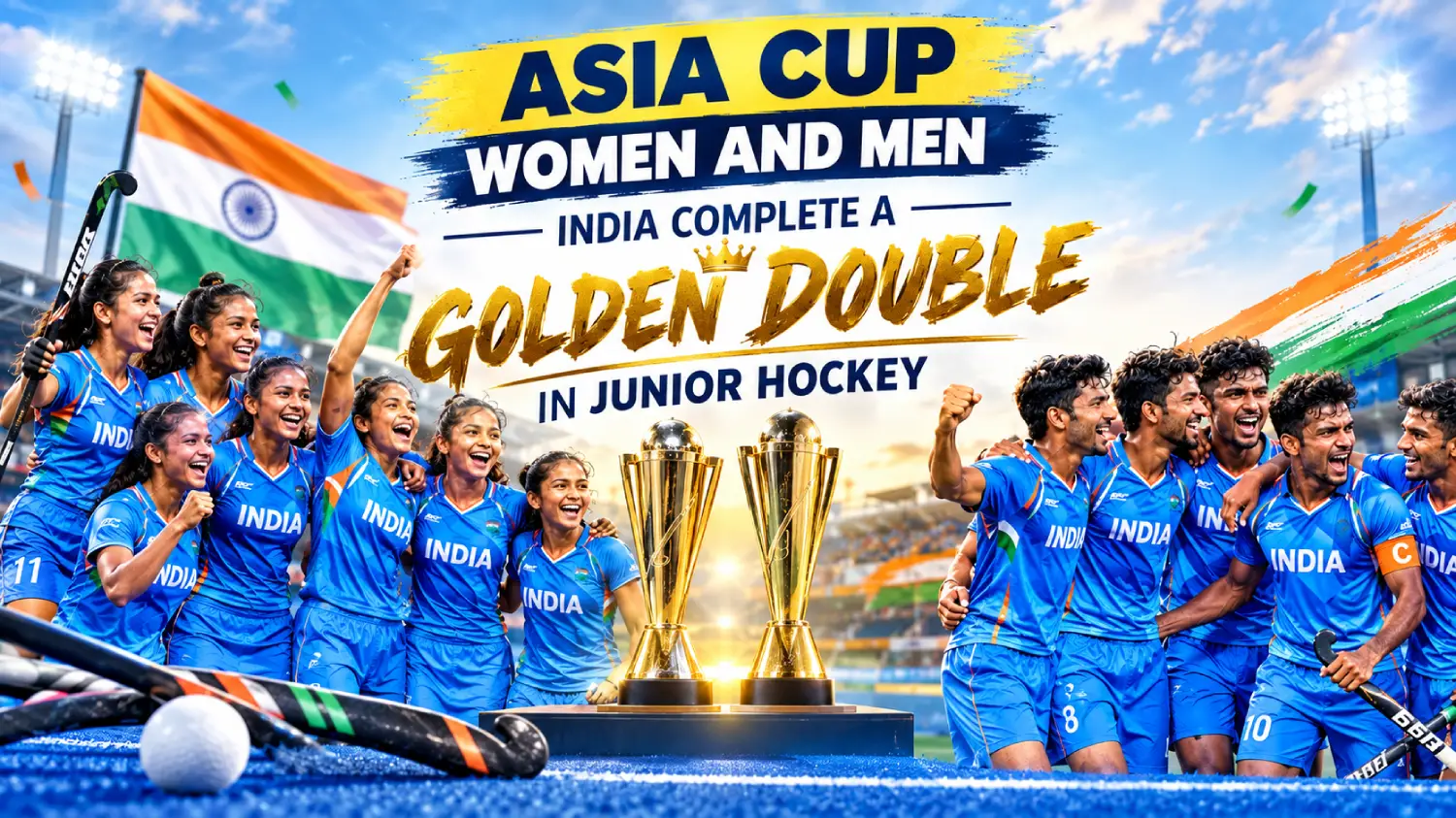

The Asia Cup women and men campaign ended in spectacular fashion for India at the AHF Junior Asia Cup 2026 in Moqi, China. The Indian women defeated the hosts 1-0, while the men beat South Korea 4-1 to successfully defend their continental titles.
The result gave India a memorable golden double and secured qualification for next year’s FIH Junior World Cups for both teams. The women completed a hat-trick of Junior Asia Cup titles, while the men won the tournament for a record sixth time and their fourth consecutive crown.
How Did India Complete a Golden Double in China at the Asia Cup Women and Men Tournament?
The final day of Asia Cup Women and Men produced two contrasting victories. India’s women had to fight through a closely contested final against China, while the men controlled their match against South Korea from the opening whistle.
Sanika Chandrakant Mane scored the only goal of the women’s final in the 17th minute. She reacted quickly to a long ball into the circle and deflected it past Chinese goalkeeper Xu Mengjiao.
China later appeared to have found an equaliser, but the goal was ruled out because the ball had entered the goal above the permitted height. That decision kept India’s advantage intact, but the match was far from over.
The Indian defence remained composed during the second half. China had only one penalty corner in the contest, and India managed the pressure effectively to preserve a narrow 1-0 victory.
The men’s final was more comfortable. India established a 3-0 lead by half-time before completing a convincing 4-1 win.
Women’s Final: Sanika Delivers the Decisive Moment
The women’s final was a test of patience, discipline and defensive organisation. China enjoyed the support of the home crowd, but India did not allow the occasion to overwhelm them.
The decisive moment came when Sanika Mane reached the ball inside the circle and produced a controlled deflection. It was a small but important piece of skill, exactly the kind of finish that can decide a tight hockey final.
After taking the lead, India resisted the temptation to over-commit. The team stayed organised and protected the 1-0 advantage through the remaining periods.
Captain and midfielder Khaidem Shileima Chanu played an important leadership role as India held their shape. The victory also marked the women’s third consecutive Junior Asia Cup title, making the achievement even more impressive.
This was India’s first Junior Asia Cup campaign under newly appointed coach Tim White. The team went through the tournament unbeaten, a strong beginning to the new coaching era.
India Women’s Road to the Title
India’s campaign showed that the final was not an isolated success. The team produced dominant performances throughout the tournament and remained unbeaten from the group stage to the final.
Their results included:
- A 4-1 victory over South Korea.
- An 11-1 win against Malaysia.
- A 7-0 victory over Japan.
- A goalless draw against China.
- A 19-0 quarter-final win over Pakistan.
- A 5-1 semi-final victory against South Korea.
- A 1-0 final win over China.
The quarter-final against Pakistan was particularly one-sided. India scored five goals in each of the opening two quarters, added three in the third and finished with another six in the final quarter.
Pooja Malik scored a hat-trick in that match, while Pakistan did not register a goal, penalty corner or penalty stroke. In the semi-final, drag-flicker Supriya also scored three times from penalty corners against South Korea.
Sanika finished as the joint-highest scorer of the tournament with seven goals. Her final-winning strike made her contribution even more significant.
Men’s Final: India Set the Pace Early
The men’s final followed a different script. India began aggressively and quickly placed South Korea under pressure.
Ajeet Yadav opened the scoring in the ninth minute. Four minutes later, captain Anmol Ekka converted a penalty corner to double the lead.
Prabhdeep Singh added a third goal in the 21st minute, giving India a commanding 3-0 advantage before half-time. The early lead allowed India to dictate the pace and forced South Korea to chase the match.
Ashu Maurya scored India’s fourth goal in the 50th minute. South Korean captain Lee Minhyeok converted a penalty stroke four minutes later, but the goal came too late to change the outcome.
The final score, India 4, South Korea 1, reflected India’s control and attacking efficiency.
Anmol Ekka Leads the Scoring Charts
Captain Anmol Ekka was one of the outstanding performers of the men’s tournament. He finished as the leading scorer with 17 goals.
His goals came across nearly every stage of India’s campaign:
- Four against Indonesia.
- Two against Japan.
- Two against South Korea.
- Six against Chinese Taipei.
- Two against Malaysia.
- One in the final against South Korea.
Anmol also showed his value in high-pressure moments. India drew 3-3 with Japan in the group stage after Anmol scored in the final minute to rescue a point.
In the semi-final against Malaysia, he scored twice from penalty corners as India secured a 3-1 victory. His leadership and goal-scoring consistency made him central to India’s title defence.
Men’s Team Completes an Unbeaten Campaign
The Indian men also remained unbeaten throughout the tournament under newly appointed coach Frederic Soyez.
Their group-stage performances were particularly emphatic. India defeated Indonesia 14-0, beat South Korea 7-3 and overwhelmed Chinese Taipei 15-0. The only interruption came against Japan, when the teams played out a 3-3 draw.
India then overcame Malaysia 3-1 in the semi-final. Goalkeeper Vivek Lakra made an important contribution by saving a penalty stroke, helping India reach the final with confidence.
The victory over South Korea secured India’s sixth men’s Junior Asia Cup title. Previous triumphs came in 2004, 2008, 2015, 2023 and 2024.
The latest success also extended India’s winning run in the competition to four consecutive titles.
What the Double Victory Means
The Asia Cup women and men triumph is important because it reflects strength across Indian junior hockey rather than success from only one team.
Both squads went through their campaigns unbeaten. Both defended their continental titles. Most importantly, both qualified for next year’s FIH Junior World Cups.
For the women, the victory confirms their status as the leading junior team in Asian hockey. Completing a hat-trick of titles requires consistency, not just one outstanding generation of players.
For the men, the sixth title and fourth consecutive championship underline India’s sustained dominance at the continental junior level. The team also showed different ways to win, recovering from a difficult draw against Japan, producing huge group-stage victories and controlling the final against South Korea.
The Road Ahead to the Junior World Cups
Qualification for the FIH Junior World Cups gives both Indian teams another major target. The Asian title is a significant achievement, but the next challenge will be competing against the strongest junior teams from around the world.
The women will carry confidence from their unbeaten run and their ability to win both high-scoring matches and tight defensive contests. Their 19-0 victory over Pakistan showed their attacking depth, while the 1-0 final against China demonstrated their composure under pressure.
The men will enter the global tournament with an impressive scoring record and several players capable of deciding matches. Anmol Ekka’s 17 goals, Prabhdeep Singh’s five-goal performance against Indonesia and India’s 15-0 win over Chinese Taipei highlighted their attacking range.
However, international competition will demand greater defensive discipline and sharper execution against teams that may offer fewer scoring opportunities.
Read More Blogs :
1. T20 Cricket This Week
2. India vs Afghanistan T20I
Frequently Asked Questions
What happened in the Junior Asia Cup 2026 hockey finals?
India’s women defeated China 1-0, while the men beat South Korea 4-1. Both teams successfully defended their Junior Asia Cup titles.
How many Junior Asia Cup titles have the Indian women won?
The Indian women completed a hat-trick of Junior Asia Cup titles with their victory over China.
How many times have the Indian men won the Junior Asia Cup?
The Indian men won the tournament for the sixth time. They have also secured four consecutive titles.
Who scored the winning goal for India’s women?
Sanika Chandrakant Mane scored the only goal in the women’s final in the 17th minute.
Who was the top scorer in the men’s tournament?
Indian captain Anmol Ekka finished as the leading scorer with 17 goals.
Did India qualify for the Junior World Cups?
Yes. Both the Indian men’s and women’s teams qualified for next year’s FIH Junior World Cups.
How does this add value for Indian Bettors
For Indian bettors and sports fans, the Asia Cup women and men finals offered two contrasting matches: India’s women secured a narrow 1-0 win over China through Sanika Mane’s 17th-minute goal and disciplined defending, while the men took control early to defeat South Korea 4-1. The results highlight the importance of studying team form, scoring patterns, penalty corners and match conditions rather than relying only on reputation. Anmol Ekka’s tournament-leading 17 goals further underlined India’s attacking strength. However, these statistics should be treated as sporting analysis, not guaranteed betting advice, especially since the tournament involved junior athletes.
Final Takeaway
The Asia Cup women and men success has given Indian hockey fans plenty to celebrate. The women showed patience and defensive strength in a narrow win over China, while the men produced an authoritative performance against South Korea.
Sanika Mane’s decisive goal, Anmol Ekka’s tournament-leading 17 goals and the contributions of players such as Kuldeep Yadav, Prabhdeep Singh, Supriya and Vivek Lakra made the campaign memorable.
India now turns its attention to the Junior World Cups. If both teams can carry the same discipline, confidence and attacking intent onto the global stage, this golden double could become the beginning of an even bigger chapter in Indian hockey.
[ Log In Our Website ]